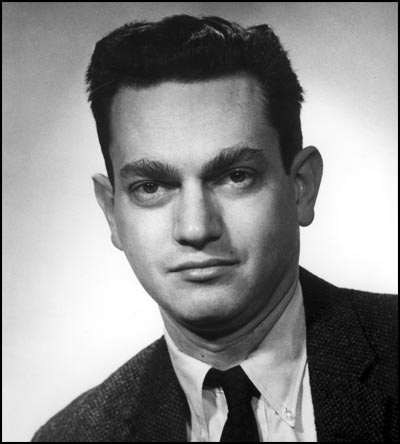
Their experiment
required a cell-free system, created when cell walls
are ruptured and release
their contents. The material inside cells is called cytoplasm,
or sap, which can still synthesize
protein but only when the correct kind of RNA is added,
allowing the scientists to control the
experiment. Nirenberg and Matthaei chose
E. Coli bacteria
cells, and ground them up using a mortar
and pestle to release the cytoplasm, or sap, they would
use in their experiments. The scientists,
working by themselves for the most part, and often late into
the night, would use the sap itself to force the
creation of a protein. The experiment used 20 test tubes,
each filled with a different
amino acid.
For each individual experiment, 19 test tubes were cold and
one was radioactively tagged so
the scientists could watch the reaction. The hot amino
acid would change every time they did
the experiment. Nirenberg wanted to know which amino
acid would be incorporated into a
protein following the addition of a particular type of
synthetic RNA.
On Saturday, May 27, 1961, at three o'clock
in the morning, Matthaei combined the synthetic
RNA made only of uracil (called poly-U) with cell
sap derived from E. coli bacteria and added it
to each of 20 test tubes. This time the hot test
tube was phenylalanine. The results were
spectacular and simple at the same time: after an
hour, the control tubes showed a background
level of 70 counts, whereas the hot tube showed 38,000
counts per milligram of protein. The
experiment showed that a chain of the repeating
bases
uracil forced a protein chain made of one
repeating amino acid, phenylalanine. The code could
be broken! UUU=Phenylalaline was a
breakthrough experiment result for Nirenberg and
Matthaei.
The two kept their breakthrough a secret from the larger
scientific community–though many NIH colleagues
knew of it –until they could complete further experiments
with other strands of synthetic RNA (Poly-A, for example)
and prepare papers for publication. They had solved
with an experiment what others had been unable to solve
with theoretical explanations and mathematical models.
It was only a few months before the discovery made Nirenberg a celebrity. In August, at the
International Congress of Biochemistry in Moscow,
he presented his paper to a small group. One
of the listening scientists convinced the conference
leaders to invite Nirenberg to repeat his
performance. Speaking before the assembled congress
of more than a thousand people, Nirenberg
electrified the scientific community. Within months,
his picture appeared in magazines around
the world and he was a highly sought-after lecturer.
Nirenberg's method of testing synthetic RNA
in a cell-free system was a key technical
innovation. However, once this technique for decoding
the relationship of mRNA to amino acids
was publicly announced in 1961, there was still much
work to do before the code was
deciphered. The scientists had to determine which
bases made up each
codon, then determine the
sequence of bases in the codons. This represented
an enormous amount of work.
At the same time, Nobel laureate Severo Ochoa was
busy working on the coding problem in his
own laboratory at New York University Medical School.
Ochoa had a big staff, and Nirenberg was worried he would not be able to keep up.
By the end of 1961, Matthaei had completed
his fellowship and moved back to Germany. But NIH
came to Nirenberg's side to help. Faced
with the possibility of helping the first NIH scientist
win a Nobel prize, many NIH scientists put aside their own work to help Nirenberg in deciphering
the mRNA codons for amino acids.
Dr. DeWitt Stetten,
Jr., director of the National Institute
of Arthritis and Metabolic Diseases, called
this period of collaboration NIH's finest
hour. All in all, more than 20 people came
through
Nirenberg's laboratory. He needed scientists
at all levels, postdoctoral fellows, and laboratory
technicians to assist him in his important work. |